Protect Your Palms
The Coconut Rhinoceros Beetle (CRB) is an invasive pest that threatens Hawaii's coconut and palm trees. Early action saves your trees.
Email: [email protected]
Call or text: (808) 731-9232
Describe the location, take a photo if it is safe to do so, and do not move the beetle
What Is CRB?
The Coconut Rhinoceros Beetle (Oryctes rhinoceros) is a large black beetle — about 2 inches long — with a distinctive horn on its head. It bores into the crowns of coconut and other palms to feed, leaving behind distinctive V-shaped or diamond-shaped cuts in young fronds.
CRB is originally from Southeast Asia. It has now spread to Hawaii, where it poses a serious threat to coconut palms and other trees important to farming and the landscape.
Why It Matters in Hawaii
- CRB attacks the growing tip of the palm. Repeated attacks can destroy the crown and kill the tree.
- A single female beetle lays about 50 eggs in mulch and compost piles — populations grow fast.
- The beetle is active at night and hides during the day, making it hard to spot.
- Once established in an area, CRB is very difficult to eradicate.
What to Do Right Now
- Look for V-shaped cuts in young palm fronds — this is the first sign of CRB damage.
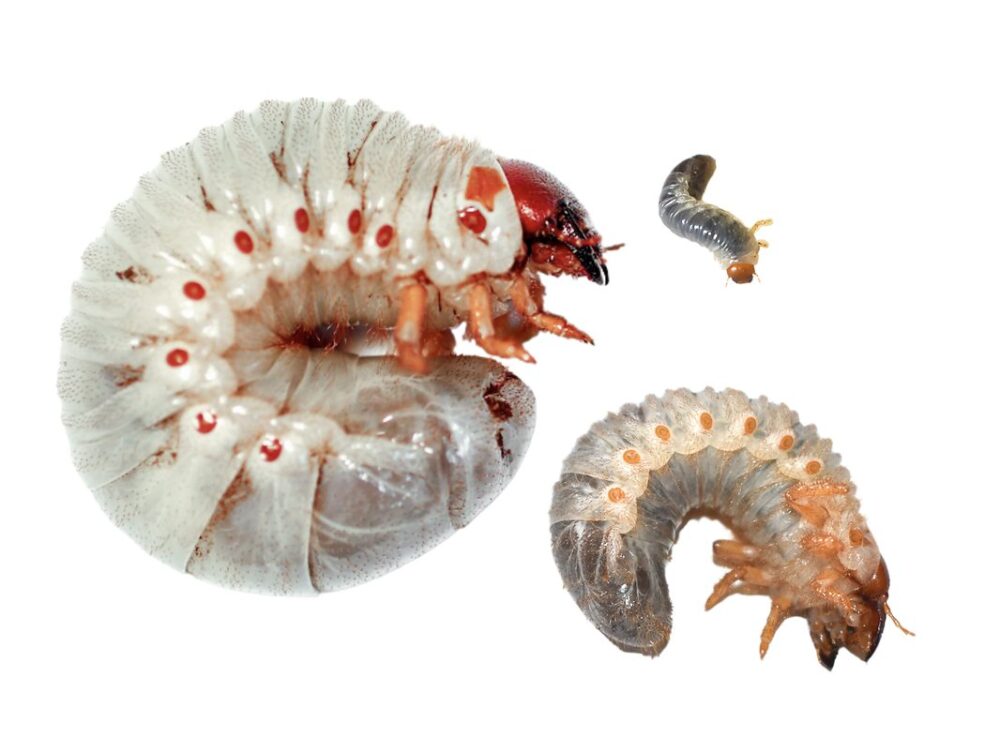
- Check your mulch and compost piles for C-shaped white larvae.
- Cover or seal any mulch piles — exposed organic material is a CRB breeding ground.
- If you see a beetle or larvae, report it immediately (contact info above).
Identification
CRB can be confused with other beetles. Here is how to tell them apart.
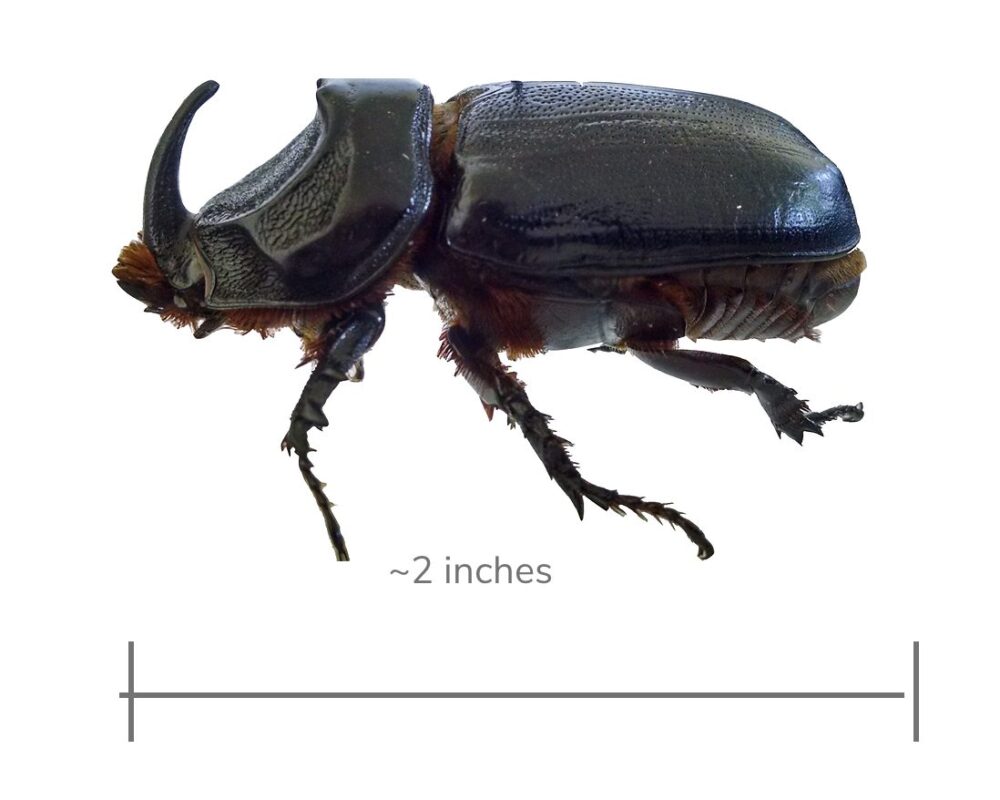
Adult CRB
- Size: About 2 inches (40–50 mm) long
- Color: Jet black, shiny
- Horn: Prominent curved horn on the head (larger on males)
- Behavior: Nocturnal — active at night, hides in debris during the day
- Flight: Strong flier; can travel between properties
CRB Larva (Grub)
- Shape: C-shaped, curled grub
- Color: Creamy white body, brown head
- Size: Up to 3–4 inches (100 mm) when fully grown
- Where found: Buried in mulch piles, compost, decaying wood, and stumps
- Duration: Larva stage lasts 3–5 months
Pupa Stage
After the larva stage, CRB forms a pupa inside a casing in the soil or organic material. The pupa stage lasts about 2–3 weeks before the adult beetle emerges. Pupae are reddish-brown and shaped like a curled adult beetle.
CRB vs. Look-Alike Beetles
Not every large black beetle is a CRB. Here is a quick comparison:
| Feature | Coconut Rhinoceros Beetle (CRB) | Dung Beetle | Oriental Flower Beetle |
|---|---|---|---|
| Size | ~2 inches (40–50 mm) | Smaller, ~0.5–1 inch | Smaller, ~0.75–1 inch |
| Color | Solid jet black | Black to dark brown | Metallic green or tan with markings |
| Horn | Prominent horn on head | No horn | No horn |
| Harms palms? | Yes — report immediately | No — beneficial | No — harmless to palms |
| Where found | Palm crowns; mulch piles | Soil, animal waste | Flowers; fruit |
Key Identification Rule
If the beetle is large (2 inches), jet black, and has a horn on its head — it is almost certainly CRB. Report it right away.
Signs of CRB Damage on Palms
- V-shaped or diamond-shaped cuts in unfurled young fronds — the most reliable early sign
- Fronds that look like they were cut with scissors or a hole-punch
- Sawdust-like material (called frass) at the base of fronds or on the trunk
- Adults visible at night near the crown of the palm
- In severe cases: dead or dying crown, no new fronds emerging
Lifecycle
Understanding CRB's life stages helps you know when and where to act.
Egg
~2 weeks
Laid 5–15 cm below the surface of mulch, compost, or decaying wood. A female lays about 50 eggs in her lifetime.
Larva (Grub)
3–5 months
C-shaped white grub with a brown head. Goes through 3 growth stages (instars) entirely underground in organic material. This is the longest stage.
Pupa
2–3 weeks
The grub transforms inside a sealed casing in the soil. The adult beetle forms inside before emerging.
Adult
3–5 months
Emerges at night, flies to palm crowns to feed and mate. The adult only actively feeds for about 42 days but lives 3–5 months.
Most Important Lifecycle Fact
CRB spends nearly 10 months of its life in breeding material — mulch piles, compost, decaying stumps, and green waste. The adult beetle only leaves to feed on palms for about 42 days. Controlling the breeding sites is the most powerful thing you can do.
Where CRB Breeds
- Mulch and wood chip piles
- Compost heaps
- Piles of green waste (yard debris)
- Decaying stumps and fallen logs
- Decomposing coconut husks and fronds
When Adults Are Active
- Nocturnal — flies and feeds after dark
- Most active after rain events
- Can fly significant distances to find palms
- Bores into the crown (growing tip) of palms to feed on sap
- One palm can be attacked by multiple beetles
Prevention & Treatment
There is no single silver bullet. The best results come from combining several approaches. Click each card to expand the details.
Managing where and how you store organic material is the single most important thing you can do. CRB cannot breed without a pile of decaying material to lay eggs in.
Four Key Steps
- Contain your mulch. Store mulch in a thick, sealed container or bag so beetles cannot get in to lay eggs.
- Cover piles with netting. Use fine mesh netting (1/2 inch or smaller) over any mulch or compost piles you cannot seal.
- Use mulch quickly. Don't let mulch piles sit for more than 4 months — the longer they sit, the more time CRB has to breed in them.
- Spread mulch thin. Apply mulch in a thin layer so it dries out quickly. Thin, dry mulch is much harder for CRB to breed in. It also lets chickens and other birds scratch for and eat the larvae.
- Remove and properly dispose of dead or fallen palms — split and dry the wood, then burn it or chip it finely
- Avoid large stockpiles of organic matter near your palms
- Chop and burn any decayed logs on your property
- If you find CRB larvae in mulch, expose them to sunlight — they will not survive drying out
Scientists are testing plant-based oils as a safer, more natural way to control CRB. Early results are encouraging.
Eucalyptus Oil
Eucalyptus oil has shown promise in laboratory and field trials as a repellent and contact insecticide against CRB adults.
Basil Oil
- Basil oil has shown approximately 66% mortality in adult CRB in trials
- Against young (early-stage) larvae, basil oil showed 73–100% mortality
- Works as both a contact insecticide and a repellent
Why This Matters
Chemical pesticides are generally not cost-effective for coconut palms in Hawaii. Essential oils may offer a lower-cost, lower-toxicity option — especially for small farms and home gardens. Research is ongoing.
Neem is a tree native to South Asia. Products made from neem seeds and leaves are widely used in sustainable farming as a natural pest deterrent. Neem works against CRB in several ways:
- Disrupts development — interferes with the beetle's ability to molt (shed its skin and grow)
- Reduces feeding — beetles exposed to neem may stop eating for up to 3 weeks
- Reduces reproduction — neem disrupts mating and egg-laying
- Disrupts metamorphosis — interferes with the transformation from larva to pupa to adult
Neem Products That Work Against CRB
| Treatment | How to Apply | Notes |
|---|---|---|
| Neem seed powder + sand (1:2 ratio) | Apply 150 g per palm at the base of the 3 inner fronds | Good field results; easy to apply |
| Neem seed kernel extract (20%) | Spray or apply to palm trunk and breeding sites | 92–95% effectiveness in trunk protection studies |
| Neem oil (5%) | Apply to palm trunk or mix into mulch/compost | Also controls termites; widely available |
Metarhizium anisopliae (MA) is a naturally occurring fungus found in soils around the world, including in Hawaii. It is a proven biological control agent for CRB.
Key Facts About Metarhizium
- OMRI certified — approved for use in organic farming
- Non-toxic to people, animals, and beneficial insects when used correctly
- The fungus infects CRB larvae and adults, killing them over 1–2 weeks
- Already naturally present in Hawaii's soils — applying it boosts what nature has already started
How to Apply
- Purchase a Metarhizium anisopliae product (available from agricultural suppliers; look for the OMRI label)
- Mix according to label directions
- Treat known and suspected CRB breeding sites: mulch piles, compost heaps, decaying stumps
- Re-apply after heavy rain, as water can wash the fungus away
- Works best when combined with good green waste management — fewer breeding sites means higher fungus concentration per beetle
Why It Works in Hawaii
Because Metarhizium is already present in Hawaii's soil, applying a commercial product doesn't introduce a foreign organism — it supplements something already working in your favor. The fungal spores persist in the environment and continue to infect new beetles over time.
Trapping
Traps help you monitor CRB populations on your property and reduce the number of adults reaching your palms. Trapping works best as part of a larger CRB management plan — not as a standalone solution.
A Tree Bow Tie is a fabric or netting collar placed around the palm trunk to intercept beetles as they climb up to feed.
How to Set Up
- Cut a 3 ft × 3 ft piece of Tekken netting (1-inch mesh)
- Place a 2-inch rock in the center of the netting to weigh it down
- Tie 2–3 knots in the netting to keep the rock in place
- Secure the netting around the palm trunk at the base of where fronds attach
- The netting traps beetles that are climbing into the crown to feed
Maintenance
- Check weekly — remove and dispose of any trapped beetles
- Keep the netting free of debris and weeds so you can see trapped beetles
- Replace netting if it tears or becomes too fouled
Tekken netting laid over mulch or compost piles intercepts beetles as they emerge from or attempt to enter breeding sites.
Specifications
- 1-inch mesh, 0.25 mm nylon monofilament (gill net style)
- Lay over mulch piles, compost heaps, or green waste piles
- Beetles get caught in the net as they try to enter or exit
Maintenance
- Check weekly — collect and destroy any trapped beetles
- Keep netting clear of weeds so you can spot beetles easily
- Repair any tears promptly
Barrel traps use a combination of decaying organic material and a chemical lure (pheromone) to attract adult CRB beetles and trap them.
Materials Needed
- A 55-gallon metal or plastic barrel, or a large trash can
- Decaying coconut material or other organic matter
- A piece of Tekken netting (for the top)
- A pheromone lure (available from agricultural suppliers)
- A drill for making drain holes
How to Set Up
- Fill the barrel with decaying coconut or organic material to within 6 inches of the top
- Drill several 1/4-inch drain holes near the bottom to prevent flooding during rain
- Cover the top loosely with a piece of Tekken netting secured with a bungee cord or rope
- Hang the pheromone lure just above the organic material inside the barrel
Maintenance
- Inspect monthly — remove trapped beetles, add fresh organic material as the existing material decomposes
- Check the pheromone lure weekly — replace when the liquid dries up
- Drain holes prevent the trap from flooding but check them after heavy rain
The DeFence trap is a more advanced trap design that uses solar-powered UV light plus a pheromone lure. It is considered the most effective trap type — and requires the least space and fewest materials of the four options.
How to Set Up
- Cut a 12 ft piece of Tekken netting and fold it in half to form a 6 ft section
- Secure the folded netting to a fence post or support with zip ties
- Hang a small red Solo cup in the center of the netting
- Place the solar-powered UV LED light inside or above the cup
- Add the pheromone lure in the cup — beetles are attracted to the light and scent and become entangled in the netting
Maintenance — Critical
- Check solar lights every week — solar units have a high failure rate and a dead light significantly reduces trap effectiveness
- Check the pheromone lure weekly — replace it as soon as the liquid inside dries up
- Keep the netting free of weeds and debris so you can see trapped beetles